


Cast trimming and foundries
Manual cast trimming risks workplace injuries and limits productivity
Foundries using a manual process to degate and trim castings face many challenges, including unsafe work conditions. Manually cast trimming with hammers, band saws, and chop saws leads to respiratory issues, cuts, burns, and crush injuries. Other challenges reducing productivity include part variability and movement, limited labor resources, and other factors like part damage, lubricant on parts, and floor space.
REDUCE INJURIES: On average 74.5 foundry workers experience severe injuries per year in the USA.
Plasma cast trimming reduces workplace injuries and increases throughput
Plasma cast trimming provides metal fabricators with a significantly safer and healthier work environment, reducing workplace injuries.
Degating casts with plasma also:
-
Increases efficiency and cut quality
-
Improves productivity
-
Builds operator skillsets
-
Boosts job satisfaction

Foundries gain competitive advantage cast trimming with plasma
Plasma cutting significantly reduces cycle times by quickly and accurately removing excess material from castings, resulting in higher productivity and less downtime. Plasma technology handles a variety of cast materials and thicknesses and allows for easy adjustments and quick changes in the trimming process. Additionally, integrating plasma cutting with cobots and industrial robots minimizes reliance on skilled labor, increases productivity, and reduces workplace injuries and labor costs.

Cast trimming in the automotive industry
Auto manufacturers boost profitability with robotic plasma-cutting technology
To stay competitive, auto manufacturers must excel in quality, efficiency, and cost reduction. Profitability hinges on identifying opportunities to improve efficiency. That’s why global auto manufacturers are increasingly adopting giga casting―large-scale aluminum frames with one cast―eliminating the need to weld dozens of body parts. Fewer parts decrease vehicle weight, enhance fuel efficiency, and accommodate the growing demand for battery-electric vehicles and more efficient internal combustion vehicles. Excess material from the mold must be removed once the cast part is removed from the giga press.

Robotic plasma-cutting technology benefits:
-
With small tooling changes, a new robot path can be programmed to trim any part
-
Robotic plasma cutting can rapidly be programmed to cut new parts and shapes offering a flexible trimming cell that can accommodate multiple casting designs
-
Plasma cutting has a greater tool-to-part distance (stand-off) for collision avoidance
-
A plasma cutter takes up minimal floor space, is easily integrated with robots, requires little maintenance, and has a significant lifespan

Challenges facing automotive manufacturers
-
Traditional cast trimming methods, such as trim presses, limit product design and have high capital costs, long changeover times, and higher scrap rates
-
Skilled labor shortages increase costs and reduce productivity, especially in trimming quality
-
Trim press dies are costly and time-consuming to replace, making it very tedious to implement design changes
-
Trim presses require the parts to cool down prior to trimming to avoid fractures and deformations and often require secondary operations resulting in extended cycle times
-
Manual work increases the risk of workplace injuries
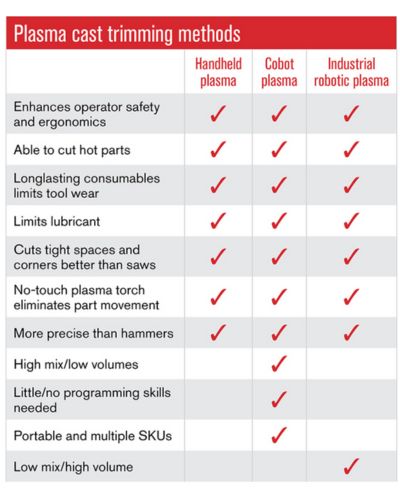
In today’s manufacturing landscape, where high performance, worker safety, and production flexibility are increasingly critical,
Hypertherm’s plasma cutting solutions have proven to be highly effective in the cast trimming process. From boosting productivity
and ensuring cut quality to minimizing operational risks and costs, plasma technology delivers tangible, measurable value for both
traditional foundries and modern manufacturing lines such as giga casting in the automotive industry.
With the ability to integrate seamlessly with industrial robots and cobots, along with a flexible design, low maintenance, and
user-friendly operation, plasma cutting is more than just a cutting tool—it is a versatile technology platform that enables manufacturers
to optimize workflows, gain a competitive edge, and adapt quickly to evolving production demands.
Hypertherm stands as the top choice for foundries aiming to transition toward safer, smarter, and more efficient production.
Other articles

LECI offers end-to-end solutions for sheet metal fabrication, covering cutting, welding, bending, punching, and automation.

Structural steel fabrication is fundamental to industrial construction, requiring high precision, fast execution, and adaptability to various environments.

The shipbuilding and oil & gas industries are heavy industrial sectors that demand high-precision metal fabrication, high productivity, and reliable performance in harsh environments.


-
R-1901, Saigon Trade Center Bld, 37 Ton Duc Thang Str., Ben Nghe W., Dist. 1, HCM City 70000, VN.
-
Long Bien, Ha Noi, VN.
-
Email: sales@leci.vn
-
Phone: (+84) 901442689
-
WhatsApp: (+84) 901442689


